
Services

Antibody Production Service
ü In Vivo Scale and Quality
ü Biosimilar Development

Antibody Conjugation Service
ü Antibody-Dye / Tracer-Conjugates
ü Antibody-Drug-Conjugates

De Novo Antibody Discovery & Development

Antibody Engineering for Structure Optimization

Peptide Synthesis Service
ü R&D Scale and Quality
ü In Vivo Scale and Quality
ü Production scale and Quality

Oligonucleotide Synthesis Service
ü R&D Scale and Quality
ü In Vivo Scale and Quality
ü Production scale and Quality
Antibody Production Service
MAMMALIAN EXPRESSION SYSTEM
Expression of Active Target Proteins
Mammalian expression system features with protein folding and post-translational modifications, whose expressed proteins are much closer to natural proteins in terms of spatial structure, protein postr-translational modifications, and biological activities. Therefore, it is widely used in the expression and production of active proteins and therapeutic antibody drugs.
1.Vector Construction
(1) Source of vector: WellMarin provides proprietary vectors or customers-specified commercial vectors.
(2) Protocol Design: WellMarin recommends selecting signal peptides, tags, and expression fragments.
2.Transient Gene Expression (TGE)
(1) Compared with stable gene expression, TGE is mainly suitable for the preparation of recombinant protein in a short period of time which is usually obtained within 10 days.
(2) The transient expression of WellMarin uses suspension cells with volumes ranging from milliliters to 100L.
3.Stable Gene Expression.
To meet long-term production needs, the entire stable transfection and screening process provides long-term stability and scale-adjustable protein production.
4.Process development and mass production.
(1) Fad-batch optimization.
(2) Culture medium screening.
(3) Downstreem purification process development.
______________________________________________________________________
Expression Methods Cell Lines
Transient Expression HEK293 (suspension with serum-free media)
Stable Expression CHO
Stable Cell Line Construktion DG44
_______________________________________________________________________________
Expression Vectors: pcDNA3.1, pIRES, pTT3, pCEP4, and pATX1, etc.
Advantages
1.Experienced Team: 10 years+ experience in protein expression, 5000+ mammalian expression projects and 500+ stable cell line construction projects.
2.Transient Expression: To meet the need for high expression, several choices of mammalian cells adapted in suspension serum free media are available, combined with proprietary expression vectors that can greatly increase yield by 3-6 times higher than conventional systems.
3.Recombinant Antibody Expression: With a set of proven vector-cell transfection high-efficiency expression system, short-term, large-scale production of recombinant antibodies above the g level.
4.Construction of Stable Cell Lines: CHO-K1 modified cell lines with independent intellectual property rights, ideal for mass production of protein, antibody drugs and other industrial-grade raw materials.
5.Class 100,000 Clean Room for Cell Culture : low endotoxin level
6.Antibody Production: From bench to bed >> Upscaling to production in R&D or GMP quality.
_________________________________________________________________________________________
Content Receivables Process Time Frame Deliverables
Content Gene synthesis 2 - 4 weeks
mammalian Gene Pilot expression & purification test 2 weeks Expression and purification test reports to decide whether expression sequence to proceed to the next step of scale up.
or vector 1L expression & purification 2 weeks Protein samples & reports
system Shake flask or bioreactor scale up 2 - 4 weeks Protein samples & reports
_______________________________________________________________________________________________________________________
Cases
Transient Expression
1. A viral hemagglutinin (HA) Trimer Expressed in HEK293.
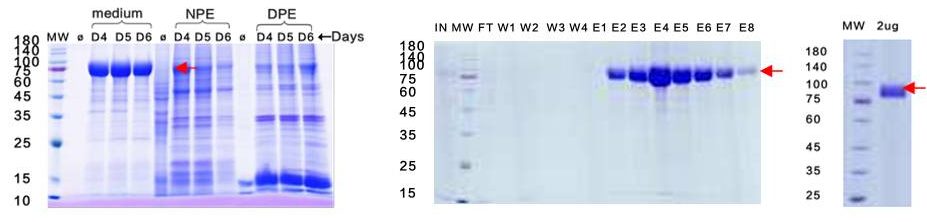
Expression test Purification QC
2. Protein Trop2 Expressed in CHO.
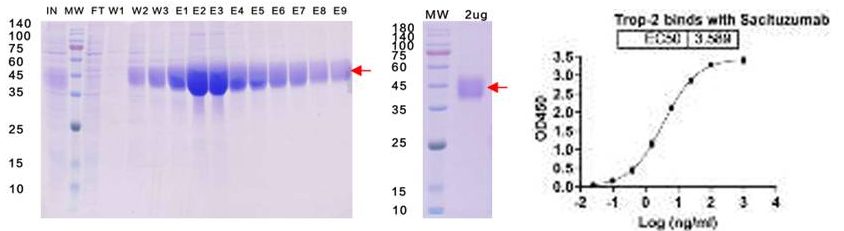
Purification QC Binding assay
De Novo Antibody Discovery & Development
PHAGE DISPLAY
ANTIBODY DISCOVERY PLATFORM
Fully Human Antibody Screening Platform
Phage display antibody technology unifies genotype and phenotype in one, combines selection ability with amplification ability, and features with powerful screening ability, which is an important technical tool for fully humanized antibody development.
There are variety of fully human antibody libraries available, which can be divided into naive antibody libraries, semi-synthetic and fully synthetic antibody libraries. However, there are many challenges to build a qualified phage library. For example, the number of donors, capacity and diversity of the library, affinity, and matching rate.
WellMarin offers a 100 billion-capacity, high-affinity, and fully humanized recombinant antibody library. With proven record, the library shows great diversity and specificity in binding with various target antigens.
Advantages
1.High sequence accuracy and capacity (10/\11pfu).
2.Two-step construction protocol to avoid mismatches introduced by PCR. The light chain library is built in advance and then heavy chains are cloned by enzymatic reactions.
3.Different from most commercially available libraries, the single-chain antibody library (scFv) is built into two light chain subtypes, κ and λ. Both libraries can be used separately.
4.All sequences are HIS tagged, expressed directly by using phagemid and purified by affinity chromatography.
QC Testing
1.Total Insertion Rate and Accuracy
The fragment insertion rate is 100%, and the antibody sequence accuracy is higher than 90%.
2.Antibody Sequence Diversity Analysis
Germline Analysis: Germline genes mainly refer to all genes contained in haploid germ cells and stemcells without rearrangement. Usually, the germline distribution of V genes in antibody sequences is analyzed.
Complementarity Determining Region (CDR) Analysis: Antibody consists of 2 regions, constant region, and variable region. A small part of the amino acid residues in the variable region are highly variable between antibodies, and this region is called the hypervariable region (HVR). There are three hypervariable regions in the V regions of the L chain and H chain. They can form precise binding with antigenic determinants in terms of spatial structure.
2.1 Germline Gene Distribution Characteristics
Humanized recombinant antibody library is divided into two light chain subtypes, κ and λ. The distribution ratio of light chain germline genes of the two subtypes and the distribution ratio of heavy chain germline genes are analyzed, indicating that the library germline gene coverage is high. The distribution characteristics are in line with the germline gene distribution law of antibody drugs.
2.2 CDR3 Length Distribution Analysis
Sequencing analysis was performed by randomly selecting 500 clones from each of the K and λ subtype libraries with no repeats. Its CDR3 length distribution conforms to the normal distribution, which is consistent with the CDR3 length distribution law of the fully human recombinant antibody drug.

K-type Light Chain Antibody CDR3 Length Distribution Ratio λ-type Light Chain CDR3 Length Distribution Ratio Heavy Chain CDR3 Length Distribution Ratio
Process
1.10/\11capacity library antigen production service/ Five protein expression systems / Peptides design and synthesis / Additional 4-6 weeks
2.Panning Method: Magnetic beads / Cell panning / Competitive panning / Additional 1-2 weeks
3.Antibody Expression: >Full length antibod
4.Mutagenesis Service: Affinity test; Point mutation
5.Specific screening in only 8 weeks (scFv/Fab/VHH)
6.Multiple rounds of phage display / Antibody enrichment / pAb validations / Monoclone selection / Sequencing / Recombinant antibody expression and purification / QC / Antibody production
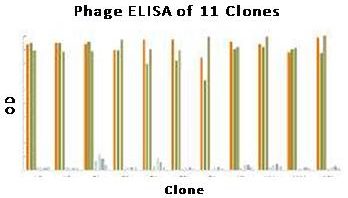
7.ELISA tests after each panning / 96* number of clones / ELISA/FCM validations / Specific antibody sequence analysis / Specificity (ELISA) Purity (SDS-PAGE) Affinity test (SPR)
8.Standard Choices: Antigen protein / Peptide / Antibody / Whole cells / DNA / Oligonucleotides / Toxin Carbohydrate / Inactivated viruses /Bacteria
9.Project initiates upon receiving antigens.
Cases
HYBRIDOMA ANTIBODY
DISCOVERY & SEQUENCING
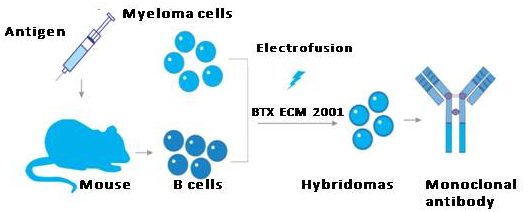
Hybridoma technology was invented in 1975 and awarded the Nobel Prize in Physiology and Medicine in 1984. It is an important milestone in the history of the whole life science research, as mouse monoclonal antibodies were introduced as powerful tool. Due to the advantages of high specificity, strong affinity, stable passage and easy handling and large-scale productions, monoclonal antibodies generated by hybridoma technology are widely used in fundamental research, in-vitro diagnostics and therapeutics.
WellMarin provides quality hybridoma cell development services, including antigen design and production, multiple immunization protocols, and electric cell fusion, screening, detection, strain determination, subtype identification, sequencing, and antibody recombinant production in mammalian cells.
Advantages
1.Various Antigens Available: proteins (five expression systems), peptides, small molecules, and DNA.
2.One-stop Service: offering total solutions from gene sequence to hybridoma development and identifications.
3.High Success Rate: experience of 2000+ mAb projects, with a success rate of 95.4%.
4.Customized Screening: design customized screening protocol according to final applications, such as WB/ IHC/IF/FC
5.Extensive Validations: WB/IHC/IF/FC and more detection methods
6.Professional Team: 10+ years’ experience in antibody research and development.
7.Downstream Engineering: Hybridoma cell sequencing, antibody humanization, recombinant antibody expression, sandwich pair screening for chemiluminescence applications, and mass production of antibodies.
____________________________________________________________________________________________________
Content Receivables Time frame Deliverables
Antigen preparation (antigen expression & purification) Antigen 4-6 months Purified monoclonal antibody (customized amount)
Host immunization Antigen 4-6 months Hybridoma cell line (customized quantity )
Hybridoma cell line construction (fusion cells, selective culture, and Screening) Antigen 4-6 months Antigen sample
Antibody production & identification (Protein A/G purification, Antigen 4-6 months Technical service report
SDS-PAGE and UV analysis, ELISA detection)
_____________________________________________________________________________________________________
SINGLE B-CELL ANTIBODY DEVELOPMENT
The rabbit single B cell antibody development technology is based an the unique properties of B cells in the immune system, where each B cell can produce specific antibodies against the antigen after being stimulated, and uses PCR technology to amplify antibody gene from the specific B cells. The variable regions of the antibody light and heavy chains are extracted, and monoclonal antibodies are obtained using in vitro recombinant expression technology. Antibodies prepared by rabbit single B antibody development technology have the characteristics of high affinity, natural heavy and light chain pairing, high specificity and more diversity. For difficult antigens, the success rate of screening target antibodies is greatly increased. Compared to the traditional mouse hybridoma method, rabbit single B cell antibody development technology has higher efficiency, has a greater chance of screening rare antibodies with high affinity, can prepare a large number of specific antibodies in a shorter time Specific antibodies. Unlike phage display technology, rabbit single B cell antibody development technology does not have light and heavy chain mismatches, and the antibody activity obtained is better.
WellMarin can provide one-stop rabbit single B cell antibody preparation services, including step from immunogen preparation, animal immunization to single B cell sorting, identification, and antibody production, to fully meet the diverse needs of customers.
BISPECIFIC ANTIBODY
Bispecific antibodies (hetero-conjugated antibodies) are a class of bifunctional hybrid antibody molecules with two different antigen-specific binding Fab segments, which can bind to different ligands and simultaneously bind to tumor antigens by specific binding. Different effector cells and molecules achieve targeted killing of tumor cells.
RAPID RABBIT
POLYCLONAL ANTIBODY DEVELOPMENT
WellMarin are committed to providing excellent and personalized antibody preparation solutions to global pharmaceutical companies, scientific research institutions and diagnostic reagent companies to facilitate scientific research exploration and industrial innovation. On order to quickly respond to the high demand from immune initiation to antibody purification through independent immune adjuvants and optimized design of rapid immunization protocols. The entire process only requires 35 days to complete. We promise to provide rabbit polyclonal antibodies with high ELISA titers (greater than 1:256,000) to meet the needs of various high-sensitivity detection and scientific research experiments, ensuring that we provide customers with the highest quality antibody products in the shortest possible time.
ANTI-IDIOTYPE ANTIBODY DEVELOPMENT
Anti-idiotype antibody refers to an antibody that can specifically bind to the idiotype of the variable region of the antibody to be tested. In the process of antibody drug development, it can specifically detect antibody drugs in vivo and is a key reagent for pharmacokinetic research. Main application is pharmacokinetic analysis of antibody drugs, immunogenicity analysis of antibody drugs and clinical development of anti-drug antibodies. WellMarin can provide a full range of technical services from antigen design and preparation, antibody development and assay development.
Antibody Engineering for Structure Optimization
ANTIBODY HUMANIZATION
Non-human antibodies have been demonstrated to induce human immune responses, which result in neutralization of administered antibody and limits the application of such antibodies in treatment of human diseases. To overcome this problem, the technology of antibody humanization has been developed. It refers to the humanization of most amino acids of mouse monoclonal antibodies through DNA recombination technology and protein engineering technology to reduce its heterogeneity (immunogenicity) while retaining the affinity and specificity of parental mouse monoclonal antibodies. Antibodies expressed by recombinant genes have both murine and human components, so they are called humanized antibodies.
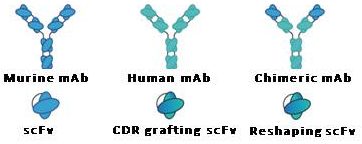
The humanization process encompasses CDR grafting, molecular modeling and sequence optimization.
Molecular modeling is an important part of this process as it allows the analysis of the contributions of individual amino-acids localized in the murine CDR loops and in the framework regions. This step is essential for identifying residues eligible for back mutations and those which can be mutated for further properties optimization. Amino-acids involved in the variable regions can be classified as follows:
1.Residues involved in the antibody-antigen interaction,
2.Residues playing a structural role, for instance by maintaining the CDR loop conformation or stabilizing the VH-VL interaction,
3.Residues interacting with the solvent.
Residues from the murine framework regions considered as critical to maintain the conformation of the CDR loops and the antibody bioactivity will be back mutated in the selected human germlines. The human germline selection is based on sequence homology. Other humanization variants can be tested. Several heavy chains and light chains are selected to generate between 9 and 18 combinations.
The different antibodies generated are further characterized and compared to the reference parental and/or chimeric antibody in order to assess their:
1.Immunogenicity,
2.Physicochemical properties (stability, aggregation rate…),
3.Pharmacological properties (affinity, specificity…),
4.Manufacturability.
Following successful testing, lead candidates can be selected for further humanization and/or CDRs sequence optimization for improvement of biophysical properties (heterogeneity, fragmentation, aggregation…), and manufacturability (bioproduction).
Steps Content Timeline Deliverables ______________________________________________________________________________________________________ Parental antibody Hybridoma cell line provided 2-3 weeks Detailed report. sequencing from by customer or developed Antibody sequence. hybridoma by WellMarin. RNA extraction and purification. Reverse transcription. cDNA amplification. Sequencing analysis. _________________________________________________________________________________________________________________ Chimeric antibody Codon optimization for ~ 7-9 weeks Detailed report. expression and mammalian expression system. Chimeric antibody sample for purification Gene synthesis. testing. Subcloning into expression vectors. Transient expression. Purification. QC analysis: SDS-PAGE, WB, UV280. _________________________________________________________________________________________________________________ Design of humanized Bioinformatics analysis. ~ 2 weeks Detailed report. antibody 3D structure modeling and Discussion with one of our identification of back mutations. therapeutic antibody experts. Human germlines selection. In silico CDR-grafting. Sequence optimization. _________________________________________________________________________________________________________________- Transient recombinant Codon optimization for ~ 7-9 weeks Detailed report. production of 9 to 18 mammalian expression system. Purified humanized antibody humanized antibody variants Gene synthesis. samples for testing. Subcloning into expression vectors. Transient expression. Purification. QC analysis: SDS-PAGE, WB, UV280. __________________________________________________________________________________________________________________ Characterization of Affinity analysis by ELISA To be determined Detailed report. humanized monoclonal against the antigen. Discussion with one of our antibody variants Analysis of antibody aggregates. therapeutic antibody experts. Affinity determination (Kd) against soluble antigen (SPR/Biacore X100). Affinity Determination (Kd) against antigen expressed on cell surface. _________________________________________________________________________________________________________________
AFFINITY MEASUREMENT
Affinity is an important parameter for measuring intermolecular interactions and an important indicator for understanding molecular recognition, biological processes, drug discovery, and screening. In the evaluation of drug efficacy, the stability evaluation of macromolecules and their complexes requires comprehensive research in terms of thermodynamics, kinetics and thermal stability, including intermolecular binding, binding speed, binding strength, and the mechanism of binding, etc.
Based on the Biacore, ForteBio Octet and Open-SPR platforms, WellMarin provides corresponding intermolecular interaction detection services, including proteins, antibodies, antibody fragments, and antibody fusion proteins.